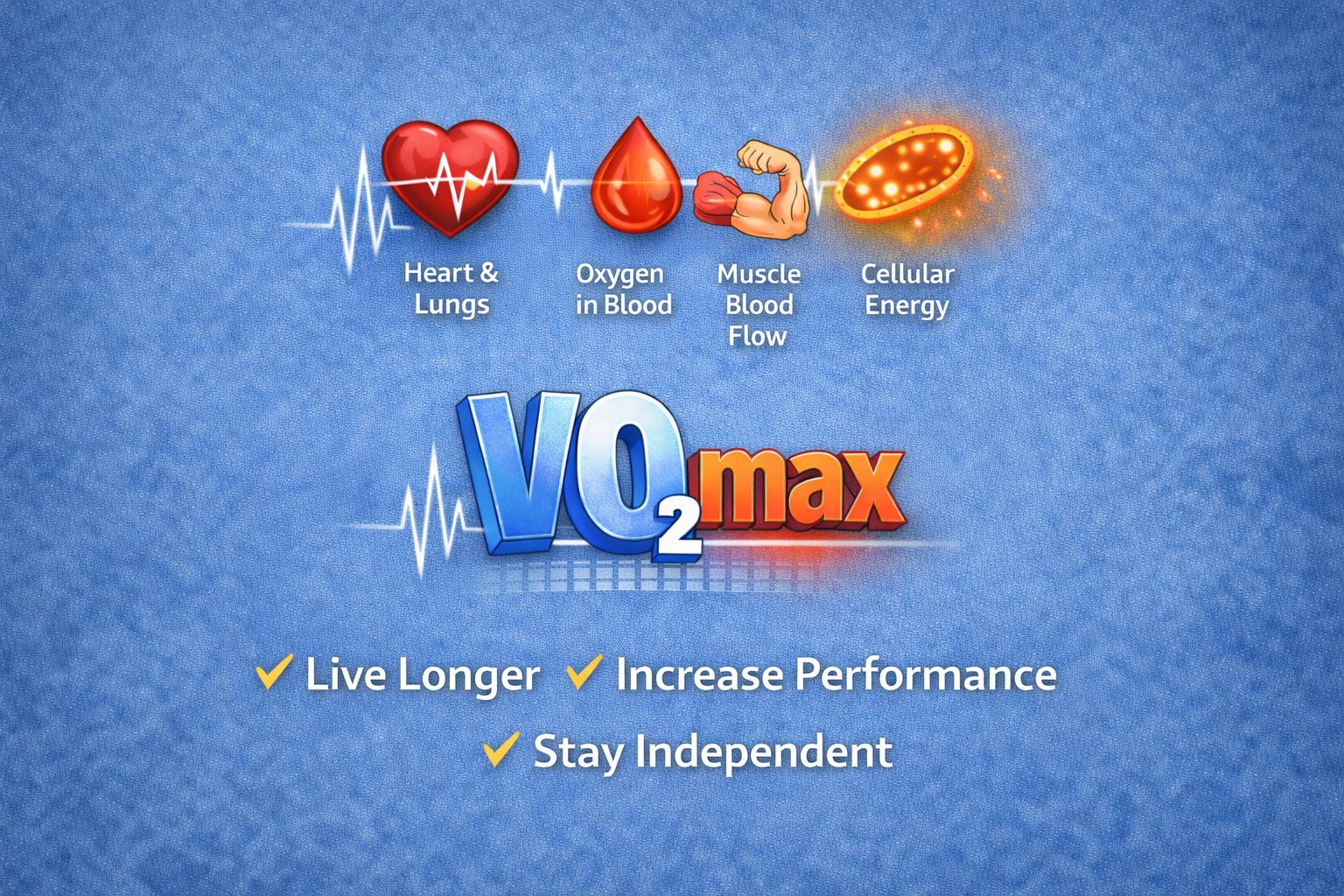

VO₂max—short for maximal volume of oxygen—is a measure of the maximum amount of oxygen your heart, lungs, and blood vessels can deliver to your muscles, and how efficiently your muscles can use that oxygen during exercise [1]. In simple terms, it reflects how large and powerful your aerobic engine is. VO2max is typically expressed as the amount of oxygen consumed per kilogram of body weight per a minute of exercise [2]; so, how much oxygen can your body use per a minute of exercise. This is called relative VO₂max, and it allows us to compare aerobic fitness between individuals of different body sizes. The higher this number, the more work you can sustain, and the longer or harder you can exercise before fatigue sets in. If you remember from our first article, our aerobic energy system requires oxygen to work and is generally more efficient at refueling our muscles, so, the more oxygen we are capable of delivering to and utilizing at our muscles, the harder or longer we can continue to exercise. The more oxygen you can deliver and use, the more resilient you become during endurance efforts—whether that’s a long hike, a hard workout, or simply keeping up with daily life as you age.
To better understand the health impact of VO₂max, it’s helpful to define a MET, or Metabolic Equivalent of Task.
For example:
[3]
Few fitness metrics are as strongly linked to long-term health as VO₂max.
Research consistently shows that each 1 MET increase in VO₂max (a 3.5 mL/kg/min improvement) is associated with a 13–15% reduction in all-cause mortality, with even larger benefits seen in less-conditioned individuals. [4,5] For example, increasing VO₂max from 30 to 33.5 can meaningfully reduce your risk of premature death, by up to 15%! For individuals with coronary artery disease, increasing VO2max by only 1 mL/kg/min (not even increasing by a full MET) results in improvement in mortality by 15% [7].
In fact, cardiorespiratory fitness has been shown to be a stronger predictor of mortality than:
[5,7,8]
Beyond mortality risk, improving VO₂max plays a critical role in preserving independence as we age. Higher cardiorespiratory fitness is associated with:
[5,9,10]
Bottom line, a better VO2max means you are less likely to die and more likely to maintain your function as you age [11].
VO₂max potential naturally declines with age—often beginning as early as the 20s or 30s at a rate of 3–6% per decade. After age 70, this decline can accelerate to more than 20% per decade. Much of this loss is tied to reductions in lean muscle mass and overall physical activity. [11]
That is some sobering information, but luckily, we can slow, halt, or even reverse this decline with exercise and striving to maximize our VO2max now and as we age. The good news is that you can improve your VO2max at any age, and the longer you train (i.e., 10 weeks of training is better than 6 weeks of training), the better the improvement [12]. Let’s chat about how to improve your VO2max.
VO₂max improves when the body becomes better at delivering oxygen and using it at the muscular level. There are four primary physiological mechanisms involved:
[13]
Any exercise that challenges your body outside its norm has the potential to increase your VO2max. Particularly any activity at or above 60% of your VO2Max. [14,15]
Exercise modalities can include:
While endurance training improves aerobic capacity, studies show that high-intensity interval training provides the greatest return on time invested, often producing similar or greater VO₂max gains with less total training volume. [15,16,17,18,19]. When you look at training volume, high intensity interval training is going to give you the biggest bang for your buck for increasing your VO2Max [14,20,21].
Strength training alone can improve VO2max for older adults with VO2max less than 25 ml/kg/minute and for younger adults with VO2max less than 40 ml/kg/minute [22]. This is likely due to increase in lean body mass and improvement in muscular function.
Additionally, McRae et al found that whole-body interval workouts—such as short work/rest formats using functional movements (burpees, thrusters, mountain climbers, jumping jacks) have demonstrated improvements in both cardiorespiratory fitness and muscular endurance. They did not find the same improvements in muscular endurance for general endurance training (running, etc.). This shows that high intensity interval workouts utilizing whole body functional movements does a better job of also targeting adaptations at the muscular level to improve our use of oxygen and overall performance.
This is a key reason why constantly varied, high-intensity functional training (i.e. CrossFit) is so effective for building a broad and resilient aerobic engine.
The gold standard for measuring VO2max is to complete a VO2max test in a laboratory. You wear a heart rate monitor and a mask that measures your O2 consumption and CO2 production [2]. You basically keep going on a treadmill or bike while intensity gets harder until you can’t continue or you puke. These tests are grueling and cost somewhere around $100-$250. Additionally, your performance and results can vary day to day. [13]
Studies have also shown that results from VO2max tests are specific to the modality used for the test. For example, someone’s results on a treadmill test will be different than on a stationary bike and athletes will likely test better on the machine/implement that they train more often. [13,23,24]
There are less uncomfortable and inexpensive ways to estimate your VO2max via Submaximal VO2max testing. The great thing about many of these tests, is that you can complete them on your own. Concept 2 has an online calculator to calculate your VO2max based on your 2k row time—super convenient for Fortitude Fitness members, since we test our 2k row time quarterly during our test week. Concept 2 2k Row Calculator.
Another online calculator uses your time and heart rate response to walking 1 mile as fast as possible. 1 Mile Walk Test
Fitness tracking watches such as Garmin can give you an estimate of your VO2max based on your heart rate response to different training stimuli. Check out how this is calculated from Garmin. Ultimately, this is an estimate, but if you can increase your smartwatch estimated VO2max over time, then you are very likely improving your actual VO2max, so keep up the strong work!
As suggested by Tony Leyland in a CrossFit journal article, you can use any benchmark workout to track your fitness capacity over time. If you can improve your Karen time—150 wallballs for time—there is a pretty good chance that you have improved your aerobic capacity andVO2max. Plus, the great thing about CrossFit workouts is that we test a wide range of movements, modalities and combinations of movements, therefore allowing for a more well rounded test of your aerobic engine.
VO₂max is more than a performance metric—it is one of the strongest predictors we have for longevity, resilience, and quality of life. Improving it reduces mortality risk, preserves independence as we age, and makes both daily activities and workouts feel more manageable.
The good news is that VO₂max is highly trainable at any age. A combination of consistent movement, high intensity interval training, and full body functional movements can meaningfully improve your aerobic capacity over time.
As a Fortitude Fitness member, you can feel confident that every time you step into the gym, you are doing meaningful work to improve your VO2max whether the Workout of the Day is Karen, 400m repeats, or heavy lifting. Each workout logged is an investment in your future health and function as you age. If you are showing up consistently, pushing yourself appropriately, and tracking your progress, you are already doing the most important work—one breath at a time.
[1] Haff, G. G., & Triplett, N. T. (Eds.). (2016). Essentials of strength training and conditioning (4th ed.). Human Kinetics.
[2] Warner, L. (2024, July 8). VO₂ max: What is it and how can you improve it? Harvard Health Publishing. Retrieved from https://www.health.harvard.edu/staying-healthy/vo2-max-what-is-it-and-how-can-you-improve-it
[3] Jetté, M., Sidney, K., & Blümchen, G. (1990). Metabolic equivalents (METS) in exercise testing, exercise prescription, and evaluation of functional capacity. Clinical Cardiology, 13(8), 555-565. https://doi.org/10.1002/clc.4960130809
[4] Kodama, S., Saito, K., Tanaka, S., Maki, M., Yachi, Y., Asumi, M., Sugawara, A., Totsuka, K., Shimano, H., Ohashi, Y., Yamada, N., & Sone, H. (2009). Cardiorespiratory fitness as a quantitative predictor of all-cause mortality and cardiovascular events in healthy men and women: A meta-analysis. JAMA, 301(19), 2024–2035. https://doi.org/10.1001/jama.2009.681
[5] Kaminsky, L. A. (2013). The importance of cardiorespiratory fitness in the United States: The need for a national registry: A policy statement from the American Heart Association. Circulation, 127(5), 652–662. https://doi.org/10.1161/CIR.0b013e31827ee100
[6] Keteyian, S. J., Patel, M. R., Kraus, W. E., Brawner, C. A., McConnell, M. V., Fletcher, G. F., … Kitzman, D. (2008). Peak aerobic capacity predicts prognosis in patients with coronary heart disease. Coronary Artery Disease, 19(6), 366–372. https://doi.org/10.1016/j.atherosclerosis.2008.05.020
[7] Lavie, C. J., Swift, D. L., Johannsen, N. M., Arena, R., & Church, T. S. (2012). Physical fitness: An often forgotten cardiovascular risk factor. Journal of Glycomics & Lipidomics, 2(2), Article e104. https://doi.org/10.4172/2153-0637.1000e104
[8] Myers, J., Prakash, M., Froelicher, V., Do, D., Partington, S., & Atwood, J. E. (2002). Exercise capacity and mortality among men referred for exercise testing. The New England Journal of Medicine, 346(11), 793-801. https://doi.org/10.1056/NEJMoa011858
[9] Rockwood, K., Stolee, P., & McDowell, I. (2004). Frailty in elderly people: An overview. Journal of Gerontology: Medical Sciences, 59(12), M1310–M1317. https://doi.org/10.1093/gerona/59.12.1310
[10] Rockwood, K., Song, X., & Mitnitski, A. (2011). Changes in relative fitness and frailty across the adult lifespan: Evidence from the Canadian National Population Health Survey. Canadian Medical Association Journal, 183(8), E487–E494. https://doi.org/10.1503/cmaj.101271
[11] Fleg, J. L., Morrell, C. H., Bos, A. G., Brant, L. J., Talbot, L. A., Wright, J. G., & Lakatta, E. G. (2005). Accelerated longitudinal decline of aerobic capacity in healthy older adults. Circulation, 112(5), 674-682. https://doi.org/10.1161/CIRCULATIONAHA.105.545459
[12] Huang, G. (2005). Controlled endurance exercise training and VO₂max in sedentary older adults: A meta-analysis. Journal of Clinical Nursing, 14(5), 528–537. https://doi.org/10.1111/j.0197-3118.2005.04324.x
[13] Leyland, T. (2006, December). VO₂ max: Not the gold standard? CrossFit Journal, 52, 24–30. https://library.crossfit.com/free/pdf/52_06_VO2_Not_Gold_Standard.pdf
[14] Scribbans, T. D., Vecsey, S., Hankinson, P., Foster, R., & Gurd, B. J. (2016). The effect of training intensity on VO₂max in young, trained males and females. Applied Physiology, Nutrition, and Metabolism, 41(11), 1164–1170. https://doi.org/10.1139/apnm-2016-0244
[15] Astorino, T. A., Edmunds, R. M., Clark, A., King, L., Gallant, R. M., Namm, S., Fischer, A., & Wood, K. A. (2017). High-intensity interval training increases cardiac output and VO₂max. Medicine & Science in Sports & Exercise, 49(2), 265–273. https://doi.org/10.1249/MSS.0000000000001122
[16] McRae, G., Payne, A., & Zelt, J. (2012). Extremely low volume, whole-body aerobic–resistance training improves aerobic fitness and muscular endurance in women. Applied Physiology, Nutrition, and Metabolism, 37(6), 1124–1131. https://doi.org/10.1139/h2012-093
[17] Milanović, Z., Sporiš, G., & Weston, M. (2015). Effectiveness of high-intensity interval training (HIT) and continuous endurance training for VO₂max improvements: A systematic review and meta-analysis of controlled trials. Sports Medicine, 45(10), 1469–1481. https://doi.org/10.1007/s40279-015-0365-0
[18] Burgomaster, K. A., Hughes, S. C., Heigenhauser, G. J. F., Bradwell, S. N., & Gibala, M. J. (2008). Similar metabolic adaptations during exercise after low volume sprint interval and traditional endurance training in humans. The Journal of Physiology, 586(1), 151–160. https://doi.org/10.1113/jphysiol.2007.142109
[19] Crowley, E., McNarry, M. A., & O’Donovan, G. (2022). The effect of exercise training intensity on VO₂max in healthy adults: A systematic review and meta-analysis. Journal of Sports Science & Medicine, 21(1), 1–11. https://doi.org/10.1155/2022/9310710
[20] Helgerud, J., Høydal, K., Wang, E., Karlsen, T., Berg, P., Bjerkaas, M., Simonsen, T., Helgesen, C., Hjorth, N., Bach, R., & Hoff, J. (2007). Aerobic high-intensity intervals improve VO₂max more than moderate training. Medicine & Science in Sports & Exercise, 39(4), 665–671. https://doi.org/10.1249/mss.0b013e3180304570
[21] Bacon, A. P., Carter, R. E., Ogle, E. A., & Joyner, M. J. (2013). VO₂max trainability and high‐intensity interval training in humans: A meta‐analysis. PLoS ONE, 8(9), Article e73182. https://doi.org/10.1371/journal.pone.0073182
[22] Ozaki, H., Loenneke, J. P., Thiebaud, R. S., & Abe, T. (2013). Resistance training-induced increase in VO₂max in young and older subjects. European Review of Aging and Physical Activity, 10(2), 107–116. https://doi.org/10.1007/s11556-013-0120-1
[23] Ricci, J., & Léger, L. A. (1983). VO₂max of cyclists from treadmill, bicycle ergometer and velodrome tests. European Journal of Applied Physiology and Occupational Physiology, 50(2), 283–289. https://doi.org/10.1007/BF00422167
[24] Price, S., Wiecha, S., Cieśliński, I., Śliż, D., Kasiak, P. S., Gruba, G., & Mamcarz, A. (2021). Differences between treadmill and cycle ergometer cardiopulmonary exercise testing results in amateur triathletes and their association with body composition and body mass index (Version 1). Research Square. https://doi.org/10.21203/rs.3.rs-917362/v1