

Most of us know we feel better after a good night's sleep, but the benefits go far beyond waking up refreshed. Sleep is essential for recovery, cognitive function, hormone regulation, immune health, and emotional wellbeing. In many ways, it serves as the foundation that supports the rest of our healthy habits, making it one of the most important—and often overlooked—components of overall wellness.
Prefer to listen about sleep, then check out this recording of this information here
Mental Wellbeing
During sleep, our mind processes information from our day, clears out metabolic waste, and creates and breaks down neural networks and memories (Patel et al., 2024). Pretty important stuff for us to keep functioning mentally. Sleep deprivation has been linked to increased risk of depression and anxiety as well as other mental health disorders, with these symptoms improving with improved sleep habits (Baglioni et al., 2016), (Alfonso et al., 2017), (Torquati et al., 2019), (Freman et al., 2017), (Patel et al., 2024), (Scott et al., 2021).
Hormone Regulation
Several key hormones are released or regulated by our sleep quality and stages. These include growth hormone, testosterone, leptin, grehlin, cortisol, and thyroid hormones.
When we sleep less and/or have lower quality sleep, these hormones can be thrown out of whack and wreak havoc on our health and wellness. A decrease in deep sleep quality and/or duration will result in less growth hormone release and inhibit our bodies ability to recover from physical activity. A decrease in REM sleep (we will talk more about the stages of sleep shortly) leads to a decrease in testosterone levels and its myriad of benefits. Sleep deprivation leads to an increase in grehlin and cortisol as well as a decrease in leptin, leading to increased appetite and increased craving for high calorie, processed foods (Jiao et al., 2025). These hormonal changes likely explain the increased risk of obesity, diabetes, and cardiovascular disease associated with poor sleep (Jiao et al., 2025).
During a normal night of sleep, we go through several stages of sleep. There are different ways to define the stages of sleep, and for our purposes we will use the following stages of sleep:
As discussed above deep sleep and REM sleep are both important for key hormone regulation, and we need both stages. We typically get more deep sleep in the first half of the night and more REM sleep in the second half of the night (Patel et al., 2024). Throughout the night we cycle through these from awake to light to deep to REM, repeating in approximately 90 minute cycles (Patel et al., 2024). Our sleep is regulated by a number of factors and hormones. One complex system worth discussing is our circadian rhythm, which is an internal 24 hour clock in our bodies that helps to regulate sleep/wake cycles, hormones, and appetite (Vitaterna et al., 2001). The circardian rhythm regulates melatonin release, which is important for pushing us toward sleep at the end of the day (Ruan et al., 2021)(Patel et al., 2024). Here are some habits that can positively affect our circadian rhythm to improve our sleep quality and consistency.
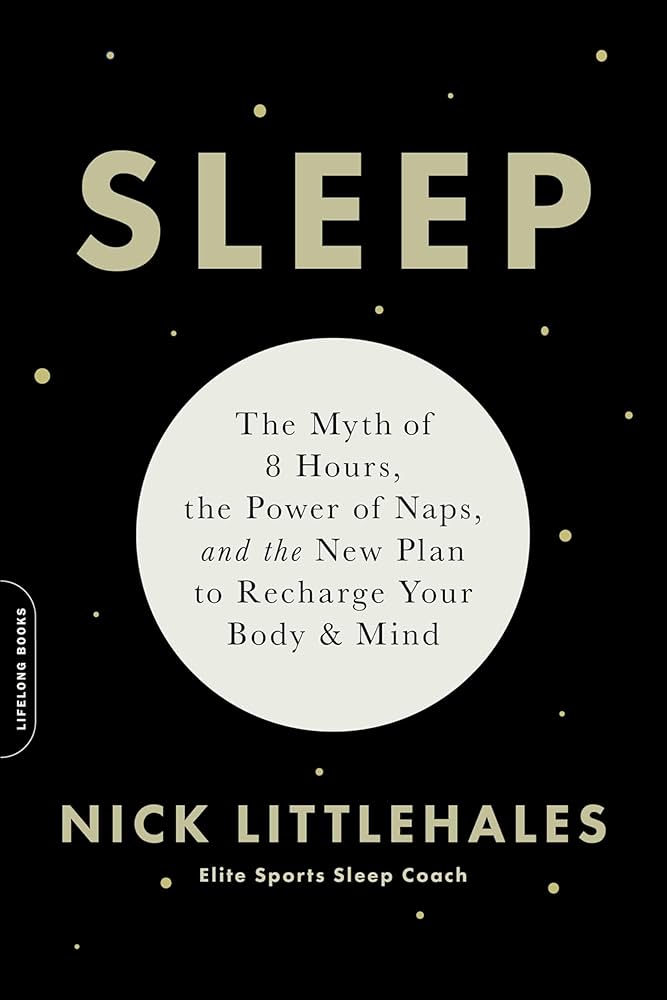
A great resource if you are looking for more information on sleep is the book “Sleep: The Myth of 8 hours, the Power of Naps, and the New Plan to Recharge your Body & Mind” by Nick Littlehales. He dives deep into the lessons he has learned working as an elite sports sleep coach for many years. The primary system he uses to improve sleep quality is called R90. R90 taps into the natural 90 minute sleep cycles our body goes through each night to improve the quality of our sleep. Lying in bed for 8-10 hours a night isn’t helpful if you are tossing and turning and your hamster wheel is spinning. By focusing on consistent wake up times, bed times, and the 90 minute sleep cycles, you can coach your body and mind into knowing when it is time to sleep to help you fall asleep quicker and have more restorative sleep.
The first step in R90 is to set a consistent wake up. Look at your week and determine what is the earliest you have to wake up on any given day, then set that as your consistent wake time. Then you need to think about what your sleep duration goals are based on sleep cycles. Studies show an increase risk of coronary heart disease and stroke if you consistently get less than 6 hours of sleep OR more than 9 hours of sleep (Jiao et al., 2025). Interesting to think that too much sleep can be a bad thing.
Most of us should shoot for 6-9 hours of sleep per a night. If we are using 90 minute sleep cycles to determine how long we should be sleeping, then we could choose to aim for 6 hours (4 cycles), 7.5 hours (5 cycles), or 9 hours (6 cycles). In R90, you set a weekly goal for the number of sleep cycles based off of your desired number of cycles each night, so if you function best with 7.5 hours of sleep (5 cycles) then you have a 35 cycle sleep week. The power of setting a weekly goal verse a nightly goal for sleep cycles gives us flexibility and decreases stress about hitting our sleep goals every single night. If life gets in the way and you can’t get your full 7.5 cycles one night, then you can make up that sleep with naps or adding an extra sleep cycle another night.
Naps, if timed well, are very restorative and help to catch up on your sleep cycle goals. You can do a power nap of 30 minutes or a full 1.5 hour nap, either will count as a sleep cycle for R90. There are a few time windows where our drive for sleep is higher and naps would be more advantageous, which are, ~1-3 pm, and ~5-7pm. It's probably best to reserve a full 1.5 hour naps for the 1-3pm time period as taking one at 5-7pm might disturb your normal night time sleep.
From there, you want to aim to go bed and be drifting off to lala land at a time that allows for you to hit full sleep cycles rather than partial sleep cycles. So, if your consistent wake up time is 7:30 am and your ideal number of sleep cycles is 5 (7.5 hours), then your consistent bed time (AKA falling asleep by) would be midnight.
Another important piece of the R90 philosophy is creating a pre and post sleep routine. We want to put work away, decrease lights and screen exposure, limit stimulants, and limit large meals or significant fluid consumption 90 minutes before going to bed. This helps prep our body for sleep. Additionally, we want to have a routine for when we wake up to allow our mind to ease into the day to allow for quality sleep rather than sleep where we are worrying about the start of our day. Our post sleep routine should be about 90 minutes as well and should include early morning sunlight, eating breakfast, maybe some exercise, and easing into our work day. We should avoid hopping right to work when we wake up.
An interesting component to the R90 program is to make sure we are hitting full sleep cycles and not partial sleep cycles. So, if you get home at 11:30pm and your bedtime is set for 12pm, you won’t have enough time to do your pre-sleep routine. The R90 method would suggest that rather than rushing to get to bed, you should complete your pre-sleep routine and aim for the next sleep window to hit 4 cycles of sleep. This means that you would go through your pre-sleep routine and aim to be asleep by 1:30am to allow you to get 4 full, quality sleep cycles. Then you strategize how to make up that missed sleep cycle with a nap or earlier bed time in the next few days.
Ultimately, sleep is important for our physical and mental health and wellbeing. Decreased sleep duration and quality can lead to negative hormonal changes and mental health issues. Improving your sleep hygiene and habits and utilizing the R90 method can improve your sleep quality and consistency, leading to a happier, better, version of yourself. If you want to learn more, check out the recording of the seminar talk I did for the gym on sleep, check out Nick’s book, and/or chat with me after class.
Patel, A. K., Reddy, V., Shumway, K. R., & Araujo, J. F. (2024, 01 26). Physiology, Sleep Stages. National Library of Medicine. Retrieved 02 06, 2026, from https://www.ncbi.nlm.nih.gov/books/NBK526132/
Baglioni, C., Nanovska, S., Regen, W., Spiegelhalder, K., Feige, B., Nissen, C., Reynolds, C. F. III, & Riemann, D. (2016). Sleep and mental disorders: A meta-analysis of polysomnographic research. Psychological Bulletin, 142(9), 969–990. https://doi.org/10.1037/bul0000053
Alfonso, P., Fonseca, M., & Pires, J.F. (2017, July). Impact of working hours on sleep and mental health. Occupational Medicine, 67(5), 377-382. Oxford Academic. https://doi.org/10.1093/occmed/kqx054
Torquati L, Mielke GI, Brown WJ, Burton NW, Kolbe-Alexander TL. Shift Work and Poor Mental Health: A Meta-Analysis of Longitudinal Studies. Am J Public Health. 2019 Nov;109(11):e13-e20. doi: 10.2105/AJPH.2019.305278. Epub 2019 Sep 19. PMID: 31536404; PMCID: PMC6775929.
Freeman D, Sheaves B, Goodwin GM, Yu LM, Nickless A, Harrison PJ, Emsley R, Luik AI, Foster RG, Wadekar V, Hinds C, Gumley A, Jones R, Lightman S, Jones S, Bentall R, Kinderman P, Rowse G, Brugha T, Blagrove M, Gregory AM, Fleming L, Walklet E, Glazebrook C, Davies EB, Hollis C, Haddock G, John B, Coulson M, Fowler D, Pugh K, Cape J, Moseley P, Brown G, Hughes C, Obonsawin M, Coker S, Watkins E, Schwannauer M, MacMahon K, Siriwardena AN, Espie CA. The effects of improving sleep on mental health (OASIS): a randomised controlled trial with mediation analysis. Lancet Psychiatry. 2017 Oct;4(10):749-758. doi: 10.1016/S2215-0366(17)30328-0. Epub 2017 Sep 6. PMID: 28888927; PMCID: PMC5614772.
Scott A, Webb T, Martyn-St James M, Rowse G, Weich S. Improving sleep quality leads to better mental health: A meta-analysis of randomised controlled trials, Sleep Medicine Reviews, Volume 60, 2021, 101556, ISSN 1087-0792, https://doi.org/10.1016/j.smrv.2021.101556.
Jiao, Y., Butoyi, C., Zhang, Q., Intchasso Adotey, S. A. A., Chen, M., Shen, W., Wang, D., Yuan, G., & Jia, J. (2025). Sleep disorders impact hormonal regulation: Unravelling the relationship among sleep disorders, hormones and metabolic diseases. Diabetology & Metabolic Syndrome, 17(1), 305. https://doi.org/10.1186/s13098-025-01871-w
Tyagi V, Scordo M, Yoon RS, Liporace FA, Greene LW. Revisiting the role of testosterone: Are we missing something? Rev Urol. 2017;19(1):16-24. doi: 10.3909/riu0716. PMID: 28522926; PMCID: PMC5434832.
LeWine, H. E. (2024, April 3). Understanding the stress response. Harvard Health. Retrieved February 14, 2026, from https://www.health.harvard.edu/staying-healthy/understanding-the-stress-response
Vitaterna, M. H., Takahashi, J. S., & Turek, F. W. (2001). Overview of Circadian Rhythms. Alcohol Research & Health, 25(2), 85-93. PMC. Retrieved February 14, 2026, from https://pmc.ncbi.nlm.nih.gov/articles/PMC6707128/
Ruan, W., Yuan, X., & Eltzschig, H. K. (2021, April). Circadian rhythm as a therapeutic target. Nat Rev Drug Discovery, 20(4), 287-307. National Library of Medicine. 10.1038/s41573-020-00109-w
Banno M, Harada Y, Taniguchi M, Tobita R, Tsujimoto H, Tsujimoto Y, Kataoka Y, Noda A. 2018. Exercise can improve sleep quality: a systematic review and meta-analysis. PeerJ 6:e5172 https://doi.org/10.7717/peerj.5172
Yang, P.-Y., Ho, K.-H., Chen, H.-C., & Chien, M.-Y. (2012). Exercise training improves sleep quality in middle-aged and older adults with sleep problems: A systematic review. Journal of Physiotherapy, 58(3), 157–163. https://doi.org/10.1016/S1836-9553(12)70106-6
Chow, C. M. (2022). Sleep Hygiene Practices: Where to Now? Hygiene, 2(3), 146-151. https://doi.org/10.3390/hygiene2030013
Irish LA, Kline CE, Gunn HE, Buysse DJ, Hall MH. The role of sleep hygiene in promoting public health: A review of empirical evidence. Sleep Med Rev. 2015 Aug;22:23-36. doi: 10.1016/j.smrv.2014.10.001. Epub 2014 Oct 16. PMID: 25454674; PMCID: PMC4400203.
Chen, Pao-Hui; Kuo, Hung-Yu; Chueh, Ke-Hsin. Sleep Hygiene Education: Efficacy on Sleep Quality in Working Women. Journal of Nursing Research 18(4):p 283-289, December 2010. | DOI: 10.1097/JNR.0b013e3181fbe3fd
Littlehales, N. (2018). Sleep: The myth of 8 hours, the power of naps, and the new plan to recharge your body and mind. Harper Wave.